
In 2025, brands that win won’t be the loudest—they’ll be the smartest. And it all starts with a bold, well-crafted marketing strategy and plan. Whether you’re launching something new or leveling up your current efforts, this is your blueprint for cutting through the noise, captivating your audience, and driving real results. From setting sharp goals to choosing the right channels and tracking what matters, we’ll show you how to turn strategy into action—and action into growth. Ready to build a marketing game plan that actually works? Let’s get started.
Why a Marketing Plan Matters

A marketing plan acts as a strategic roadmap, steering your business’s marketing efforts toward clearly defined objectives. It ensures that every action taken is purposeful and aligned with broader goals. Here’s why having one is vital:
Establish Clear Direction – A marketing plan clarifies what your business aims to achieve and lays out the path to get there. By defining specific goals, strategies, and tactics, it keeps your team aligned, minimises confusion, and ensures everyone is working toward the same outcome.
Identify the Right Audience – Effective marketing starts with knowing your audience. A marketing plan enables you to:
- Pinpoint your ideal customer profile
- Understand their needs, behaviours, and preferences
- Customise your messaging and outreach
Enhance Resource Efficiency – With a clear plan, you can:
- Allocate your marketing budget wisely
- Focus on the most impactful channels
- Prioritise initiatives with the greatest return on investment
Define Measurable Objectives – A comprehensive marketing plan includes SMART objectives—Specific, Measurable, Achievable, Relevant, and Time-bound. This framework allows you to:
- Monitor progress
- Analyze performance
- Refine strategies based on results
Drive Business Growth – Marketing plays a critical role in:
- Attracting new customers
- Nurturing loyalty among existing ones
- Strengthening brand recognition
A marketing plan is more than just a document—it’s a roadmap to growth, efficiency, and competitive advantage. Whether you’re launching a startup or scaling an established business, a strategic marketing plan gives you the clarity and confidence needed to move forward with purpose.
Overview of Marketing Plan Key Components
A marketing plan offers a clear framework and guidance to connect with the right audience and fulfill business objectives. Below are its eight essential elements:
- Target Market and Customer Personas: Identify your audience by detailing demographics, challenges, and motivations to customise your messaging effectively.
- Mission Statement and Value Proposition: Clearly state your brand’s purpose (such as “Promoting sustainable living”) and the unique reasons customers choose you (like “Affordable organic skincare”).
- SWOT Analysis: Evaluate your internal strengths (e.g., distinctive products) and weaknesses (e.g., limited budget), along with external opportunities (e.g., emerging trends) and threats (e.g., competitors).
- Marketing Objectives and Business Goals: Define SMART goals (for instance, achieving a 15% sales increase within six months) that align with overall business targets.
- Marketing Mix and Channels: Select strategies (such as social media or SEO) and platforms (like Instagram or email) to communicate your message efficiently.
- Budget and Resource Allocation: Distribute your budget (e.g., 40% to advertising, 30% to content) and assign resources (including team members and tools) to optimise results.
- Timeline and Roadmap: Establish a schedule outlining campaign stages and key milestones (for example, Q1 for content creation, Q2 for ad launches) to ensure smooth execution.
- KPIs and Metrics: Monitor key indicators such as conversion rates and brand awareness to evaluate performance and inform necessary adjustments.
Foundations of a Marketing Strategy
Mission Statement
A mission statement articulates the fundamental purpose of a business, serving as a compass for its marketing strategy and aligning all efforts toward a shared objective. It should be straightforward, concise, and embody the brand’s values and goals.
For instance, a sustainable clothing brand might use the mission statement: “To empower individuals with eco-friendly, stylish apparel that supports a healthier planet.” This not only communicates the brand’s focus on sustainability and fashion but also shapes its overall marketing tone.
Key Elements:
- Purpose: The reason the business exists.
- Values: The core beliefs that drive operations.
- Audience: The specific group the business aims to serve.
- Differentiation: The qualities that set the brand apart.
A compelling mission statement serves as the foundation for branding, content creation, and marketing campaigns, promoting coherence and consistency across all channels.
SWOT Analysis
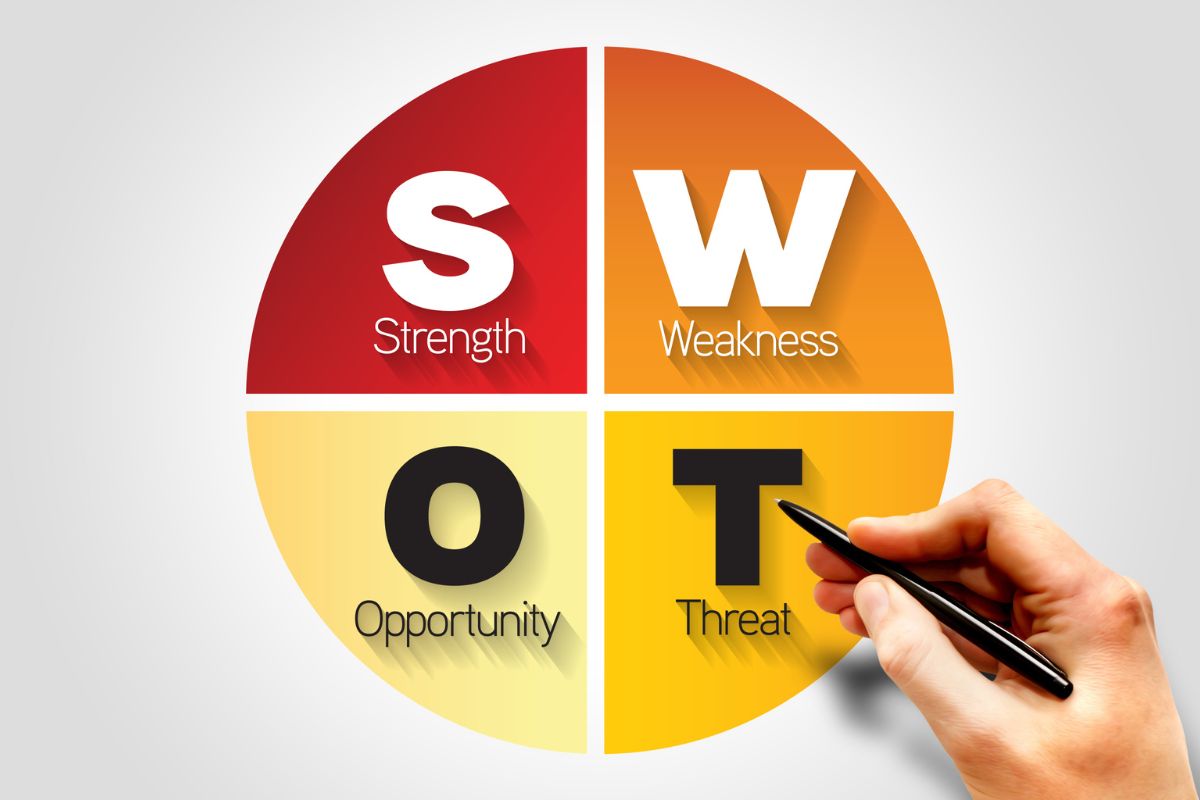
A SWOT Analysis is a strategic tool used to assess a company’s current position by examining four key areas: Strengths, Weaknesses, Opportunities, and Threats.
This framework offers a balanced perspective by combining internal factors (Strengths and Weaknesses) with external influences (Opportunities and Threats), helping businesses gain a holistic understanding of their present situation and future potential. It serves as a valuable guide for evaluating performance, uncovering areas for growth, and developing informed strategic plans.
- Strengths: Internal assets or advantages that give the business a competitive edge—such as unique product features, strong brand loyalty, or proprietary technology.
Example: A coffee shop known for using locally sourced beans and having a dedicated customer base. - Weaknesses: Internal challenges or limitations that may hinder performance, like budget constraints, low brand recognition, or inefficient operations.
Example: High production costs that limit profit margins. - Opportunities: External factors that offer potential for growth or expansion, such as emerging market trends, untapped customer segments, or strategic alliances.
Example: Increasing consumer demand for plant-based products in the food sector. - Threats: External challenges that could negatively impact the business, including rising competition, economic instability, or regulatory changes.
Example: A new competitor entering the market with significantly lower prices.
Target Audience
Identifying the right target audience is essential for making marketing efforts effective and impactful. Rather than speaking to a broad and undefined group, businesses that pinpoint their ideal customers can deliver more relevant, engaging messages. This process involves crafting detailed buyer personas based on specific demographics, psychographics, behaviours, and customer needs.
A clearly defined target audience allows businesses to align their products, messaging, and marketing channels with the preferences of those most likely to engage and convert.
Demographics: These are basic statistical characteristics that help create a general profile of your audience. Key demographic factors include: Age, Gender, Income, Education, Occupation, Location. Example: Urban women aged 25–40 with discretionary income.
Psychographics: These insights go deeper, capturing your audience’s values, lifestyle choices, interests, and attitudes. Psychographics help create emotionally resonant messaging. Example: Consumers who are environmentally conscious and actively seek sustainable, ethical brands.
Behaviours: Behavioural data reflects how customers interact with your brand and make purchasing decisions. This includes:
- Buying habits
- Brand loyalty
- Product usage
- Preferred shopping and communication channels
Example: Online shoppers who follow brands on social media and trust peer reviews before making purchases.
Needs and Pain Points: Understanding your audience’s challenges and the problems they’re trying to solve is key to offering relevant solutions. Example: A desire for stylish, eco-friendly clothing that is both affordable and high quality.
Key Elements of a Marketing Plan
Marketing Objectives
Marketing objectives set the direction for your strategy. These goals should be aligned with your broader business mission and provide a clear focus for all marketing activities.
Effective objectives are:
- Specific – Clearly define what you want to achieve (e.g., “Boost brand awareness by 20%”).
- Measurable – Include metrics to track success (e.g., website visits, lead conversions).
- Achievable – Ensure goals are realistic given your team and resources.
- Relevant – Align with customer needs and business priorities.
- Time-bound – Establish a clear deadline for completion.
Examples:
- Increase online sales by 15% during Q3.
- Gain 5,000 new social media followers within four months.
- Improve customer retention by 10% by the end of the year.
Application: Use these objectives to guide your marketing campaigns and track performance using KPIs such as engagement, revenue, and conversion rates.
Unique Selling Proposition (USP)
Your USP is the defining value that differentiates your product, service, or brand from the competition. It answers the question: Why should customers choose you?
Consider:
- What unique value do you offer—better quality, exclusive features, or exceptional service?
- How does your offering address customer pain points or desires?
- What makes your brand stand out in the market?
Example: A skincare brand’s USP might be: “100% organic, cruelty-free products in biodegradable packaging”—a clear value proposition for eco-conscious consumers.
Development Tips:
- Study competitors to find market gaps you can fill.
- Emphasise the benefits that matter most to your audience.
- Keep your USP short, clear, and compelling—use it consistently across messaging.
Application: Embed your USP into all marketing content—from ad copy and websites to social media bios—to consistently communicate your brand’s unique value.
Market Research

Market research provides the insights needed to build informed strategies. It helps you understand your audience, analyze competitors, and identify market trends.
Key Focus Areas:
- Customer Insights: Understand demographics, values, behaviour, and buying motivations.
- Competitive Analysis: Evaluate competitor strengths, weaknesses, pricing, and tactics.
- Market Trends: Stay ahead of industry shifts (e.g., rise in sustainable consumption, new technology).
Example: A coffee shop may discover through surveys that customers prefer locally sourced beans—insight that can shape its product strategy and branding.
Application: Use research findings to refine your target audience, enhance your USP, and select the most effective marketing channels.
Marketing Channels
Marketing channels are the mediums through which you deliver your message and connect with your audience. The right mix helps you reach people where they are most active and engaged.
Types of Channels:
- Digital: Social media (e.g., TikTok, Instagram), email marketing, websites, SEO, online ads.
- Traditional: Print advertising, television, radio, direct mail, and in-person events.
- Physical Presence: Retail locations, pop-up shops, or trade shows.
Selecting Channels:
- Where does your audience spend their time?
- Which platforms best support your goals and budget?
- How does each channel contribute to the customer journey—awareness, consideration, conversion, or retention?
Example: A handmade jewelry brand targeting young women might focus on Instagram and Pinterest for their visual appeal, with email newsletters to drive repeat sales.
Application:
- Build a balanced channel strategy based on reach, cost, and ROI.
- Assign responsibilities and create timelines for each tactic.
- Monitor key performance indicators (e.g., open rates, click-through rates, engagement) to optimise results.
Developing the Strategy
The 4 Ps Framework
The “Four Ps”—Product, Price, Place, and Promotion—form a foundational framework for building a marketing strategy that aligns with customer needs and market conditions. By tailoring each element to your target segments, you can develop a focused approach that drives engagement, differentiation, and business growth. Below is a breakdown of each component and how to apply it effectively.
Product
Your product or service should directly address the needs and preferences of your target market. It’s essential to regularly evaluate whether your offering delivers value and stands out in a competitive landscape.
Key Questions:
- What specific customer needs does this product or service fulfill?
- What unique features or benefits set it apart from competitors?
- Should you enhance your offering by adding new features, variations, or personalisation?
Example: A handmade jewelry brand targeting young women could offer customisable designs or use sustainable materials to appeal to eco-conscious buyers.
Action: Use customer feedback and market research to refine your product and ensure it remains relevant and desirable.
Price
Pricing reflects your brand’s market position and directly influences profitability. It requires a careful balance between customer affordability and business sustainability.
Key Questions:
- What are the total costs involved—production, marketing, distribution, and sales?
- How does your pricing compare with competitors, and can it be adjusted to strengthen your market position?
- Could strategies like tiered pricing, subscriptions, or bundled offerings add value?
Example: A coffee shop might introduce a subscription model offering daily brews at a discount, attracting loyal customers and securing consistent income.
Action: Review cost structures, study competitor pricing, and evaluate customer willingness to pay to establish an optimal pricing strategy.
Place
Place refers to the channels and locations where customers discover, access, and purchase your product or service—both physical and digital.
Key Questions:
- Where does your audience typically look for products like yours—retail stores, online platforms, social media?
Are you present in those spaces? If not, which new channels could you explore? - How can you improve the customer experience at the point of sale?
Example: A handmade jewelry brand could sell through Instagram Shop and Etsy to reach its target audience where they already spend time.
Action: Map the customer journey to identify high-impact touchpoints and ensure your product is available and visible where your audience shops.
Promotion
Promotion covers all the ways you communicate with your audience to raise awareness and drive sales. This includes advertising, content marketing, social media, email campaigns, PR, and in-person engagement.
Key Questions:
- Which communication channels does your audience use most frequently?
- What messaging speaks to their values, pain points, and aspirations?
- How can you integrate multiple tactics for stronger impact?
Example: A jewelry brand might focus on Instagram and Pinterest with visually striking posts and influencer collaborations, while using email campaigns to offer exclusive discounts and retain existing customers.
Action: Create a promotion strategy that uses the most effective channels and messaging for your audience, ensuring consistency with your brand’s voice and mission.
Strategic Implementation Tips
To execute the Four Ps successfully:
- Know Your Audience: Use detailed customer personas to inform all decisions. For example, if your audience values sustainability, emphasise eco-friendly practices across all marketing elements.
- Set a Timeline: Establish clear deadlines for each initiative (e.g., launch a new Instagram campaign in Q2, enter a new marketplace by Q3).
- Assign Ownership: Designate responsible team members for each “P”—marketing, operations, product development, etc.
- Track & Optimise: Regularly measure key performance indicators (KPIs) like sales, engagement, and conversion rates. Adjust tactics as needed for continuous improvement.
Tactical Action Plan
Here’s a streamlined 9-step guide to creating an effective marketing plan:
Step 1: Clarify Your Mission, Vision, and Value Proposition
Define your company’s core purpose, long-term vision, and what sets you apart. Craft a clear mission statement (e.g., “Inspiring healthier lifestyles through organic snacks”) and a compelling value proposition (e.g., “Affordable, eco-friendly snacks for health-conscious families”).
Step 2: Pinpoint Your Target Audience and Develop Buyer Personas
Use market research to build detailed customer profiles. Outline demographics, key challenges, and preferred platforms (e.g., LinkedIn for professionals, TikTok for Gen Z) to tailor your messaging effectively.
Step 3: Establish Clear, Measurable Marketing Goals
Set SMART objectives—Specific, Measurable, Achievable, Relevant, and Time-bound. Examples include “Grow newsletter subscribers by 15% in Q2” or “Increase Instagram engagement by 20% within 60 days.”
Step 4: Analyze Your Competitors
Conduct a thorough competitive analysis to gain insight into their strategies and market positioning. Use SWOT (Strengths, Weaknesses, Opportunities, Threats) to identify advantages and areas where you can differentiate.
Step 5: Define Your Marketing Mix and Content Plan
Select the right mix of channels (e.g., social media, SEO, email) and content types (e.g., blog posts, videos, ads) to deliver your message. Develop a content calendar to stay consistent and organised.
Step 6: Allocate Your Marketing Budget
Distribute your budget across tools, campaigns, and resources. Focus on initiatives with the highest return, while leaving room to pivot as needed.
Step 7: Develop a Campaign Timeline and Roadmap
Outline a schedule of key campaigns, milestones, and team responsibilities. Use a visual calendar to map phases (e.g., Q1: content production, Q2: campaign rollout) and keep efforts aligned.
Step 8: Choose KPIs and Track Key Metrics
Identify specific performance indicators to monitor progress—such as conversion rates, ROI, or social engagement. Assign 3–5 KPIs per goal to stay focused and data-driven.
Step 9: Communicate with Stakeholders and Stay Agile
Keep stakeholders informed with regular updates and performance reports. Revisit and refine the plan monthly based on analytics and changing market conditions.
Budgeting and Resource Allocation
Budget Planning
Budget planning is the process of allocating financial resources to marketing activities to ensure that your efforts align with business goals and deliver measurable results. An effective marketing budget prioritises high-impact strategies while allowing flexibility for unforeseen opportunities.
- Define Marketing Objectives: Start by aligning your budget with specific, measurable goals such as increasing brand awareness by 20% or boosting sales by 15% within a set period.
- Estimate Costs: Outline projected costs for each initiative—this includes expenses for:
- Paid advertising (e.g., Google Ads, social media)
- Content production (e.g., blog articles, videos)
- Marketing tools and platforms
- Personnel or outsourcing
- Promotions and events
- Prioritise Spending: Focus on strategies that are most likely to drive results with your target audience. For instance, if your audience is highly active on Instagram, allocate more funds toward social media advertising.
- Set a Contingency Fund: Reserve 5–10% of your total marketing budget for unplanned opportunities or adjustments, such as last-minute ad campaigns or trending content opportunities.
- Track Return on Investment (ROI): Identify KPIs—like cost per acquisition (CPA), conversion rates, or return on ad spend (ROAS)—to evaluate how effectively your budget is being used.
Tips for Effective Budget Planning
- Use past campaign performance and industry benchmarks to inform your estimates.
- Balance short-term tactics (e.g., limited-time promotions) with long-term investments (e.g., SEO).
- Review and revise your budget quarterly to respond to market trends or performance data.
Resource Management
Resource management ensures that the right people, tools, and creative assets are available and used efficiently to execute your marketing strategy. Effective allocation maximises output while minimising waste and delays.
Human Resources
- Assign Roles by Skill Set: Designate team members for specific tasks, such as a social media manager for digital engagement or a designer for brand visuals.
- Outsource Strategically: Use freelancers or agencies for specialised tasks or to supplement limited in-house capacity.
Technological Resources
- Use Automation Tools: Platforms like Hootsuite (for scheduling) or Mailchimp (for email campaigns) streamline repetitive tasks.
- Invest in Channel-Specific Software: Choose tools that support your marketing priorities—like CRM systems, analytics dashboards, or SEO platforms.
Creative Resources
- Develop Reusable Assets: Templates, brand guidelines, and pre-approved content reduce production time and ensure consistency.
- Invest in High-Quality Content: Focus resources on content that strongly connects with your audience, such as professional videos, infographics, or blog articles.
Best Practices for Resource Management
- Assess Capacity: Evaluate workload and adjust assignments to avoid burnout or delays.
- Automate Where Possible: Use automation to handle repetitive tasks and free up time for strategic work.
- Monitor Usage: Track how time and tools are used to identify inefficiencies or underutilised assets.
- Cross-Train Team Members: Empower team members to handle multiple roles, increasing flexibility during busy periods.
Measuring Success
Performance Metrics

Performance metrics, or Key Performance Indicators (KPIs), are quantifiable indicators that measure the effectiveness of your marketing efforts. These metrics provide actionable insights and help determine whether your strategies are achieving your desired outcomes. Crucially, KPIs should align with your marketing objectives and guide ongoing optimisation.
Sales and Revenue Metrics: These metrics directly relate to the financial impact of your marketing initiatives.
- Revenue Growth: Tracks the increase in sales generated from specific campaigns.
- Conversion Rate: Measures the percentage of users who complete a desired action (e.g., making a purchase, signing up for a newsletter).
Engagement Metrics: Engagement KPIs gauge how actively your audience is interacting with your content and brand.
- Social Media Engagement: Includes likes, comments, shares, saves, and click-through rates on platforms like Instagram, TikTok, or Facebook.
- Website Traffic: Measures visits, unique users, bounce rates, and time spent on pages.
Customer Metrics: These indicators reflect customer satisfaction, loyalty, and long-term brand health.
- Customer Retention Rate: Tracks the percentage of customers who return for repeat purchases.
- Net Promoter Score (NPS): Gauges how likely customers are to recommend your brand to others.
Acquisition Metrics: Acquisition KPIs measure the efficiency of your efforts to attract new leads and customers.
- Cost Per Lead (CPL): The average cost to acquire a new lead via marketing campaigns.
- Customer Acquisition Cost (CAC): The total cost of acquiring a new customer, factoring in advertising, sales, and other expenses.
Brand Awareness Metrics: These KPIs measure the visibility and reach of your brand among your target audience.
- Impressions: Number of times your ad or content is displayed, regardless of engagement.
- Reach: Number of unique users who have seen your content.
Performance metrics are essential for understanding what’s working and what isn’t. By selecting and monitoring the right KPIs, you can make informed decisions, improve campaign efficiency, and ultimately drive better business outcomes.
Review and Adjustment
To maintain strong performance and adapt to changing conditions, marketing strategies must be regularly reviewed and refined. This continuous improvement process includes the following key steps:
Define Clear Goals and Timelines: Start by setting SMART goals—Specific, Measurable, Achievable, Relevant, and Time-bound. Establish defined periods for evaluation, such as monthly or quarterly, to ensure consistent tracking and accountability.
Analyze Performance Data: Regularly monitor KPIs and marketing metrics to uncover trends, highlight successes, and identify areas needing attention across all campaigns and channels.
Spot Issues and Uncover Opportunities: Evaluate where your current efforts are falling short and where new potential exists. This might include underperforming ad sets, declining engagement, or newly emerging customer behaviours that present fresh possibilities.
Make Data-Driven Adjustments: Based on insights, refine your approach by:
- Testing new tactics or formats
- Updating campaign messaging
- Reallocating budget to higher-performing areas
- Exploring untapped platforms or audiences
Leverage Customer Feedback: Use qualitative insights from customer surveys, reviews, and social listening to stay in tune with your audience. These inputs help shape strategies that better reflect customer preferences and enhance satisfaction.
Measure the Results of Adjustments: Track how each change impacts performance. Compare before-and-after metrics to determine what’s working and iterate further based on what you learn.
Embrace Continuous Optimisation: Marketing strategy isn’t static. It’s an ongoing, iterative process that enables businesses to remain agile, responsive, and competitive in fast-changing markets.
Real-World Examples
Case Studies
Safe Haven Family Shelter: A Strategic, Mission-Driven Marketing Approach
Safe Haven Family Shelter is a nonprofit organisation dedicated to helping families overcome homelessness through housing support and comprehensive services. Its 2022 marketing plan illustrates how purpose-driven organisations can use strategic communication to tell their story and strengthen their role as a sector leader.
This marketing plan is notable for its action-oriented structure. Each objective is paired with specific action steps, with responsibilities clearly assigned to individual staff members. This not only ensures accountability but also provides a step-by-step roadmap for implementing marketing initiatives effectively.
To enhance planning and consistency, Safe Haven includes tools like an editorial calendar and a social media calendar. These resources help the team coordinate messaging across platforms, ensuring content aligns with overarching organisational goals—whether that’s increasing donor engagement, boosting visibility, or promoting advocacy.
By combining storytelling with structured execution, Safe Haven successfully positions itself as both a compassionate service provider and a trusted voice in the fight against homelessness. The plan demonstrates how nonprofits can use thoughtful marketing to amplify their mission, improve internal coordination, and engage the community more meaningfully.
See more» The Marketing Plan of Safe Haven Family Shelter
Nike’s Customer-Centric Marketing Strategy
Nike has become a global powerhouse not only due to its innovative products but also because of its unwavering focus on the customer. At the heart of its success lies a marketing strategy built around understanding and serving the needs of its audience. By incorporating key elements of modern marketing, Nike demonstrates how a customer-first approach can foster loyalty, engagement, and long-term growth.
Customer Segmentation: Nike excels at identifying and serving diverse customer segments, from casual fitness enthusiasts to elite athletes. Its NIKEiD customisation platform enables users to create personalised footwear and apparel, offering a tailored experience that strengthens brand connection and reflects Nike’s dedication to individual expression.
Marketing Collaborations: Strategic partnerships with prominent athletes and organisations—such as the NBA—are central to Nike’s marketing efforts. These collaborations result in exclusive products and high-impact campaigns, helping Nike resonate with target audiences and build trust through shared credibility.
Interactive Content: Through digital tools like the Nike+ Run Club app, Nike transforms user engagement into meaningful interaction. The app goes beyond tracking workouts—it fosters a global fitness community, delivers guided coaching, and challenges users to push their limits, turning them into active participants in the brand experience.
Visual Storytelling: Nike’s advertising is rich with emotional and motivational narratives. Campaigns like “Just Do It” are designed to inspire and empower, connecting with consumers on a deeper level. These stories elevate Nike from a sportswear brand to a symbol of perseverance and achievement.
User Experience: With a sleek, easy-to-navigate website and efficient customer support, Nike ensures a seamless digital experience. Every interaction is designed to be user-friendly and consistent, reinforcing the brand’s professionalism and attentiveness at every stage of the customer journey.
Influencer Marketing Strategy: Nike’s endorsement deals with global sports icons—such as LeBron James, Serena Williams, and Cristiano Ronaldo—do more than boost visibility. They position Nike as the choice of champions, reinforcing its image as a high-performance, aspirational brand.
Lessons Learned
Prioritise the Customer or Audience
- Nike succeeds by deeply understanding its diverse customer segments, offering tailored experiences like NIKEiD and forging emotional connections through iconic campaigns such as “Just Do It.”
- Safe Haven focuses its messaging to resonate with key audiences—donors, volunteers, and the broader community—by sharing compelling stories that reflect its mission and impact.
Takeaway: Knowing your audience—be it customers or supporters—is essential to crafting relevant and effective marketing strategies.
Connect Goals to Actionable Steps
- Nike brings its strategic vision to life through innovation, athlete partnerships, and interactive platforms—all aligned with objectives like customer engagement and brand loyalty.
- Safe Haven employs a clear action plan by linking each marketing goal to specific tasks and assigning responsibilities, fostering team alignment and accountability.
Takeaway: Effective marketing requires more than setting goals—it demands actionable plans and clearly defined roles to drive execution.
Harness the Power of Storytelling
- Nike uses emotionally charged narratives to inspire and motivate, aligning with customers’ values and aspirations.
- Safe Haven leverages real stories from the families it serves to build empathy, trust, and deeper community involvement.
Takeaway: Storytelling is a powerful tool across all sectors for building emotional connections and making your brand message resonate.
Use Strategic Tools to Stay Organised and Consistent
- Nike relies on digital platforms like the Nike+ Run Club app and consistent social media strategies to deliver engaging and timely content.
- Safe Haven integrates editorial and social calendars to streamline communications and maintain alignment with its organisational goals.
Takeaway: Leveraging the right tools ensures consistency, enhances team coordination, and supports long-term marketing success.
Build Authority Through Consistent Brand Messaging
- Nike reinforces its status as a global leader through innovation, influencer partnerships, and a strong brand identity centered on performance and empowerment.
- Safe Haven establishes credibility in the nonprofit space by communicating its impact clearly and consistently, reinforcing its leadership in homelessness prevention.
Takeaway: Whether in business or the nonprofit sector, consistent messaging and a clear brand voice build trust and authority.
Strategic planning for sustainable growth
Marketing strategic planning is the cornerstone of sustainable growth, far beyond merely following short-lived trends. By clearly defining goals, analyzing the market environment, and developing informed strategies, businesses can effectively navigate today’s complex landscape. This forward-thinking approach optimises resource allocation, strengthens customer connections, and builds a durable competitive edge.
Moreover, ongoing monitoring, evaluation, and adaptability are critical. As markets continuously evolve, so must marketing strategies. By adopting a flexible, data-driven approach, organisations ensure their efforts remain relevant, impactful, and aligned with long-term objectives. Ultimately, a well-crafted marketing strategic plan acts as a guiding force, steering businesses toward lasting success and resilient growth in a dynamic marketplace.
Additional Resources
SEMrush.com
SEMrush, launched in 2008 by marketing innovators, is a leading all-in-one digital marketing platform with over 3 million users worldwide. It empowers businesses to enhance their online presence through tools for SEO, content, PPC, and social media marketing.
Key features include site audits, keyword research and tracking, backlink analysis, PPC competitive research, domain comparisons, social media insights, and keyword difficulty analysis, all designed to optimise marketing strategies and drive growth.
InfluencerAuditor.com
InfluencerAuditor.com is a platform designed to streamline influencer marketing by providing tools to identify, analyse, and manage influencer partnerships. It offers in-depth analytics on influencers’ audience demographics, engagement rates, and authenticity, helping brands and marketers make data-driven decisions.
The platform enables users to discover influencers across social media channels, evaluate their performance, and optimise campaigns for maximum ROI. With features like fraud detection and detailed reporting, InfluencerAuditor.com aims to ensure transparency and effectiveness in influencer marketing strategies.
Similarweb.com
Similarweb.com is a top digital intelligence platform offering in-depth insights into website and app performance, market dynamics, and competitor analysis. Established in 2007, it uses AI-driven data aggregation and machine learning to provide real-time analytics on web traffic, user behaviour, and digital marketing tactics.
The platform enables users to compare their performance with competitors, explore traffic sources, monitor SEO and PPC efforts, and identify new market opportunities. Trusted by major companies such as Google, Amazon, and Microsoft, Similarweb supports businesses across various industries with powerful tools for market research, sales intelligence, and strategic decision-making.
See more»
- Marketing and Client Acquisition in Australia: Strategies for Success in 2025
- Digital Marketing in Australia: Trends and Strategies for 2025
- Email Marketing Laws and Compliance in Australia
- Driving Growth: The Role of Landing Pages in B2B Customer Acquisition Strategies
- Content Marketing for Customer Acquisition in 2025: Strategies, Trends, and Best Practices
- Customer Acquisition in Australia: Strategies, Metrics, and Cost Optimization for 2025
- Customer Retention Strategies: Building Loyalty and Driving Growth in the Australian Market
- Grow Your Business With SEO: Strategies, Success Stories, and Practical Tips for Small Businesses in 2025
- Customer Lifetime Value (CLV) Strategies for Growth and Efficient Acquisition in 2025
- Building Enduring Customer Loyalty in Australia: Strategies for 2025
